 KidneyCats
 Appetite: the real battle
The short answer
A kidney cat who stops eating is usually nauseated, not stubborn. Uremic toxins, high phosphorus and stomach acid all make food repulsive, and cats learn to hate a food after one bad meal. Treating the nausea, warming the food and changing the texture beat hunting for a new flavor almost every time.
Why won't my cat with kidney disease eat?
This is the part that will take up most of your emotional energy, and it's where people feel most like they're losing. So start here: she isn't being stubborn, and she hasn't given up.
Eating makes her feel worse. Uremic waste products dull her appetite, high phosphorus makes her feel unwell, and a stomach producing too much acid turns food into something that hurts. Add the mild dehydration that comes with damaged kidneys and you have a cat who feels queasy most of the time.
Which means the answer usually isn't a better flavor. It's treating the reason food stopped being appealing.
Work through it in this order
Chasing food before you've dealt with the medical reasons is how people burn through forty cans and two weeks. There's an order to this.
Work through it in this order
One at a time. Mark each one off as you and your vet deal with it, and the next step opens.
-
Nausea
An antiemetic, given thirty to sixty minutes before food. This alone fixes a lot of cats, and most nauseated cats never vomit, so absence of vomiting is not evidence against it.
-
Stomach acid
An acid reducer, if your vet agrees she needs one. Inexpensive, and it makes eating comfortable rather than sore.
-
Phosphorus
-
Hydration
A dehydrated cat is a flat cat. Fluids under the skin often bring her appetite back within a day.
-
Her mouth
A painful tooth or an ulcer looks exactly like nausea. Rule it out before you accept it is not that. In a kidney cat I treat the pain rather than reach for a dental.
-
Then, and only then, appetite stimulants
They make a comfortable cat hungry. They do not make a sick cat well. Mirtazapine or capromorelin, and the dosing rules matter.
That is the whole order. If you have worked through all six with your vet and she still will not eat, that is a conversation about how she is doing overall rather than another flavour. Knowing when it is time is the page for that, and reading it early costs nothing.
What to actually try at the bowl
None of this is a trick, and none of it costs anything.
Warm it. A few seconds in the microwave, stirred through, until it's about body temperature. Never hot, and check it with a fingertip. Cats eat with their nose first, and food straight out of the refrigerator has almost no smell.
Serve it fresh and take it away. Twenty minutes, then the bowl goes. Food that's been sitting out for four hours has gone stale and sour to a cat, and leaving it down mostly teaches her that food smells wrong.
Use a wide, shallow dish. Flat and open, so her face and whiskers aren't down inside a bowl. It takes ten seconds to try and it helps more cats than you'd expect.
Move the bowl. Away from the litter box, away from the noisy appliance, away from the other cat. Somewhere she doesn't have to keep watch while she eats.
Change the texture, not just the flavor. Pate, chunks in gravy, shredded, minced. A cat who has given up on pate will sometimes eat shredded without hesitating. Texture is a bigger lever than flavor and people almost always reach for flavor first.
Toppers, used sparingly. A spoon of the water from a can of tuna or plain chicken in water, crumbled freeze-dried chicken, a little low-sodium broth. Read the label on anything made for people and check there's no onion or garlic in it, which rules out most baby food and most gravies.
One new thing at a time. This is the discipline that matters and the one everybody breaks. If you open six cans tonight and she refuses all six while she's feeling sick, you haven't learned anything, you've just burned six options.
The appetite stimulants, and how to use them safely
Two drugs do most of this work. Both are prescriptions, both are useful, and both get used in ways that cause trouble.
Mirtazapine. A tablet, usually a small dose every two to three days rather than daily in a cat with kidney disease, because her kidneys clear it more slowly. There's also Mirataz, an ointment you rub into the inside of her ear, which suits cats who fight tablets.
The ointment is where I want to be specific, because this is the mistake I see most:
- Measure the ribbon against the tube. Don't estimate it, and don't add extra because yesterday's dose didn't seem to do much.
- Wear a glove or a finger cot. It goes through your skin too, and you don't want a dose of it.
- Alternate ears each day, and wipe the previous spot clean.
- If she shakes her head and flings some off, that was still the dose. Don't top it up.
- Too much mirtazapine looks like agitation. Constant loud vocalizing, pacing, restlessness, wide pupils, fast breathing, sometimes tremors. If that's what you're seeing, wipe her ear clean with a damp cloth and call your vet.
Capromorelin, sold as Elura. A daily liquid by mouth, and the one drug in this area specifically approved for weight loss in cats with chronic kidney disease. It works. Some cats drool at it or find the taste unpleasant, and a few get mild vomiting in the first few days.
Neither of these treats nausea. Worth repeating, because it's the usual reason they seem not to work.
Mirataz, applied properly
Video coming. I'm filming these myself.
Weigh her, don't judge by the bowl
Appetite is a terrible thing to measure by feel. You'll remember the two good days and forget the four flat ones, or the reverse on a bad week.
Buy a cheap kitchen scale, sit her in a box or a carrier on top of it, and weigh her once a week on the same day. Write it down with the date. A quarter of a pound lost over a month tells you something no impression of her appetite ever will, and weight is the number I'd rather have at a recheck than almost anything else.
There's more on what's worth tracking at home on the monitoring page.
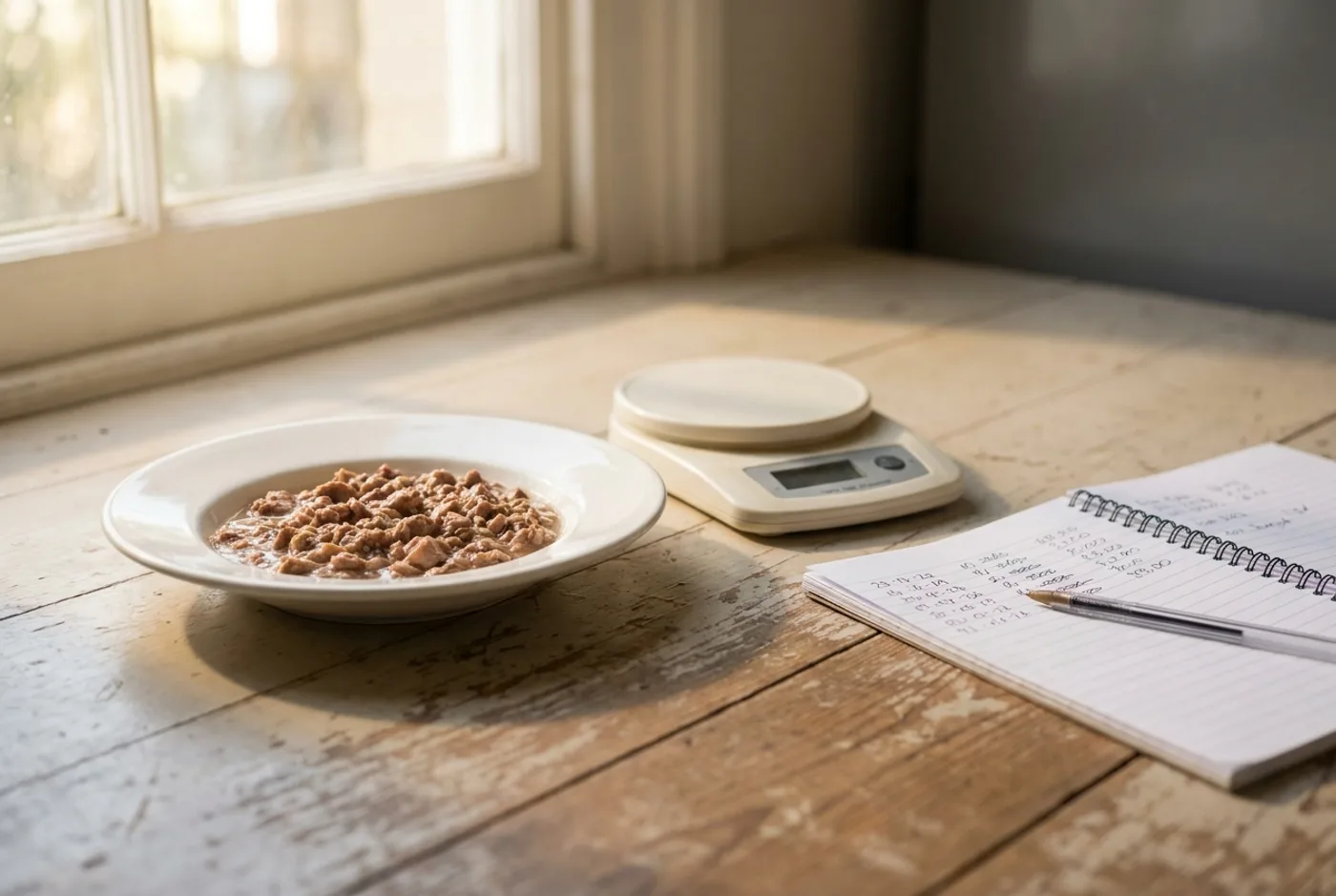
The notebook is the real subject of that picture. A wide shallow dish, a cheap scale, and somewhere to write the number down is the whole kit.
What about a feeding tube?
You'll come across this one, so here's where I stand on it.
A feeding tube, usually an esophagostomy tube running through the side of the neck into the esophagus, does solve the mechanical problem. Food, water and medication go down it in a couple of minutes and the nightly fight in the kitchen ends. That part is true and I'm not going to pretend otherwise.
The part that isn't discussed enough is what it takes to place one. It's general anesthesia. And anesthesia drops blood pressure, lower blood pressure means less blood moving through kidneys that are already short of it, and a cat with damaged kidneys can come out of an anesthetic a step worse and not come back up. So the price of the tube isn't the tube. It's most likely a permanent notch of kidney function, spent on an advanced cat.
Weigh that against what it buys. In a cat far enough along that she's stopped eating for good, my read is that it buys a little time rather than a lot, and it spends some of her good days on the anesthetic and the recovery to get there. I don't push them, and I wouldn't in my own cat.
If your vet has recommended one, that isn't a disagreement you need to referee. Ask two specific questions: what do they expect it to give her, in weeks rather than in principle, and how will they protect her blood pressure while she's under. If the honest answer to the first one is short, that tells you something.
And if she's reached the point where she needs to be fed rather than tempted, the real question underneath it usually isn't about tubes. It's the one on the quality of life page, and it's worth reading before you decide anything.
The part I most want you to hear
You aren't failing at this because your cat won't eat. A cat who won't eat is a medical problem having a conversation with you, and there's nearly always something concrete to be done about it.
Early on, push for the kidney diet, because lowering phosphorus genuinely buys her time. Further along, the brand on the can matters less and her eating at all matters more. If she's happy and eating something, I'm not going to spend her good days arguing with her about food.
There's more on the food itself, including how to transition without triggering a refusal, on the kidney diets page.
Questions people ask me about this
- Why won't my cat with kidney disease eat?
- Because eating makes her feel worse, not because she's digging her heels in. Uremic waste, high phosphorus and too much stomach acid all turn food into something unpleasant, and mild dehydration lays flat and queasy on top of that. A sore mouth and constipation are the other two regulars. Every one of those is treatable.
- What can I give my cat with kidney disease to stimulate her appetite?
- Two prescriptions do most of this work: mirtazapine, as a tablet or as the ear ointment Mirataz, and capromorelin, sold as Elura. Both work, and neither touches nausea, so a queasy cat needs an antiemetic first or alongside. Don't set the schedule yourself, and with the ointment more is not better.
- How long can a cat with kidney disease go without eating?
- Not long, and I'd want you to take this one seriously. Two to three days of eating nothing puts her at real risk of hepatic lipidosis, where fat floods the liver and the liver stops coping, and that turns one illness into two. Twenty-four hours of nothing is a phone call, not a wait-and-see.
- Is it better for her to eat ordinary food than nothing?
- Yes, and it isn't close. Early on I'll push hard for the kidney diet, because lower phosphorus buys real time. Further along the brand matters less than the fact that she's eating, and a binder stirred into food she likes recovers a good share of the difference.
- Why does my cat lick the gravy and leave the rest?
- Usually mild nausea. Interested in food but with a stomach saying no is exactly what gravy-licking looks like. A sore mouth produces the same behaviour, because gravy needs no chewing. Either way it's a signal, and it's worth describing to your vet in those words.
- Should I syringe feed her?
- Not routinely, and not without your vet saying so. Forcing food into a queasy cat teaches her that food, being held still and feeling sick all turn up together, and she'll hold that for weeks. Treat the nausea first, because a comfortable cat mostly feeds herself. A cat who has to be fed rather than tempted is a quality-of-life conversation, not a technique problem.
Medically reviewed by Dr. Steve Pelton, last updated . First published . Reviewed quarterly.