 KidneyCats
 Subcutaneous fluids: the complete guide
The short answer
Subcutaneous fluids means running sterile fluid under the loose skin between your cat's shoulder blades, where her body soaks it up over a few hours. It's the single most useful thing most owners learn to do at home. It looks impossible the first time and it's routine by about the fourth.
What subcutaneous fluids actually are
You're running sterile salt water under the loose skin between her shoulder blades. Her body soaks it up over the next few hours, the way a sponge takes up water.
That's it. It isn't dialysis and it isn't a treatment for the kidneys themselves. What it does is fix the dehydration that damaged kidneys cause, and dehydration is a large part of why a kidney cat feels flat, sleeps all day and won't eat.
Most owners tell me the same thing after a couple of weeks: they can see the difference on the days she's had fluids.
What you need
- A bag of fluid, usually lactated Ringer's solution
- A drip line, sometimes called a giving set
- Needles, 18 or 20 gauge, a fresh one every time
- Somewhere to hang the bag
That's the whole kit. Your vet supplies it or writes it as a prescription.
Don't buy a shorter needle to be kind. An 18 gauge is wide, which sounds worse and is actually better, because the fluid runs through faster and the whole thing is over sooner. A thin needle means a long session, and a long session is what your cat objects to.
How to do it
Set up before you get the cat. Everything ready, needle attached, air run out of the line. Cats read fumbling.
-
Warm the bag. Stand it in a sink of hot tap water for about ten minutes. Room temperature fluid feels cold going in, and cold is the single most common reason cats hate this. Never microwave a bag of fluid. It heats unevenly, and you can't tell by feel that part of it is scalding.
-
Hang it high. Higher means faster. A coat hook, a curtain rail, a nail in the wall, the top of a door. There's no need to buy an IV pole.
-
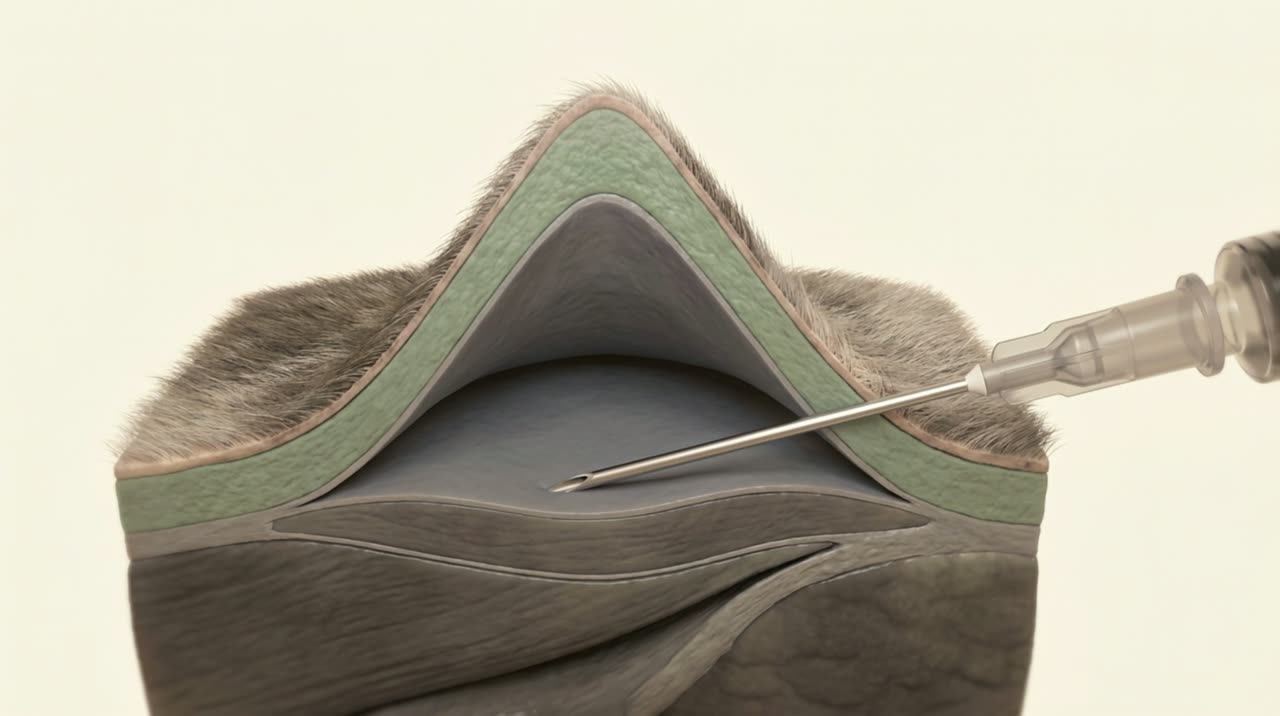
Pick your spot. The loose skin between her shoulder blades. Pinch it up into a tent with your non-dominant hand. There's a lot more slack there than you'd think.
-
Go in flat, not down. Slide the needle into the base of the tent, roughly parallel to her spine, not aiming at her back. You're going into the pocket you just made, not through it. It goes in easier than you expect.
-
Open the line and let it run. Watch the drip chamber. If nothing's moving, the needle is either not in the pocket or it's gone straight through and out the other side.
-
Take the needle out and pinch the skin for a few seconds. A drop or two of fluid leaking back out afterward is normal.
Then feed her something good. Every time, immediately, no exceptions. You want her associating this with tuna and not with being held still.
What the setup looks like
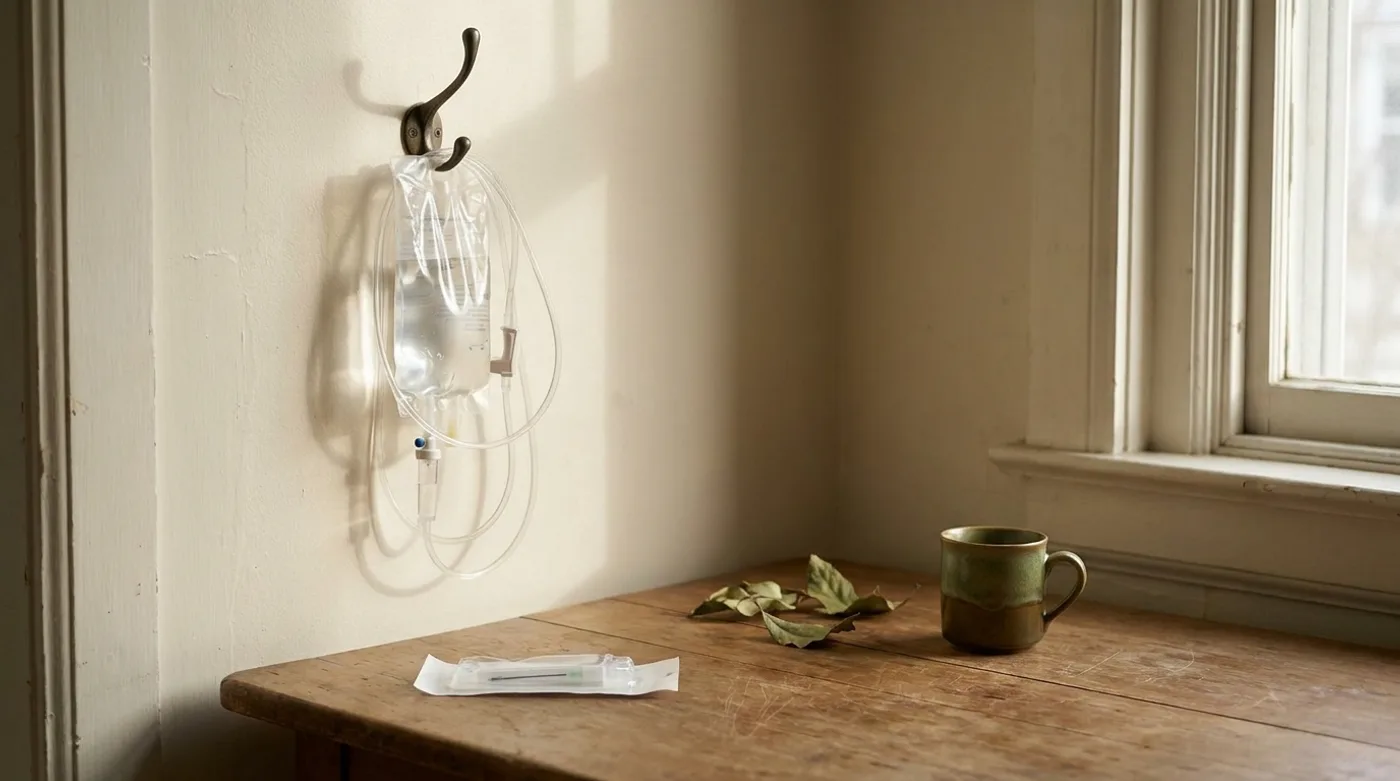
That's the whole thing: a bag, a hook, a line, a fresh needle, and a kitchen. Not a clinic, not a procedure room, and no equipment you have to buy beyond what your vet supplies.
The video
Mine isn't filmed yet. Until it is, this is the one I'd send a client to, and you can watch it here rather than going looking for it.
Loads from YouTube only when you press play, so nothing is requested from Google before then.
Giving fluids, start to finish
Video coming. I'm filming these myself.
What normally goes wrong
This is the part nobody warns you about, and it's why most people panic on day three over something that's completely fine.
The lump. There'll be a soft swelling where the fluid went in. That's the fluid, sitting there, being absorbed. It's supposed to happen.
The lump moves. Over a few hours gravity takes it downward. It can end up on her chest, or travel down a front leg. Cats sometimes limp a little because of it. This looks alarming and it's normal. It should be soft, not hot, not tender, and gone within about twelve hours.
She cries. Usually cold fluid, a dull needle, or too slow a flow. Fix those three in that order. A cat who cries every time despite all three is worth mentioning to your vet.
The needle pops out. Everybody does this. Stop the flow, bin that needle, fresh one, start again in a slightly different spot. Never re-use a needle that's touched anything, and never put a used needle back in your cat, both because it's dull now and because it isn't clean.
Air in the line. Under the skin, a small amount of air is harmless. This is not a vein. Run the line through before you start because it's tidier, but if a bubble gets through, nothing bad happens.
A bead of blood. Occasionally you'll nick a tiny vessel. Pressure for a few seconds and it stops.
She hides when she sees the bag. She's learned the sequence. Change the room, change the time of day, and go back to feeding her something excellent the second the needle is out.
There's a longer page on all of this at giving fluids when it goes wrong.
How much, and how often
Your vet decides this, and it's individual. A common starting point for an average cat is somewhere around 100 to 150 ml a session, daily or every other day.
Please don't increase it on your own because she seems dehydrated, and don't skip sessions because she seems fine. Too much fluid is a real problem in a cat with heart disease or high blood pressure, and both of those travel with kidney disease more often than people realize. If you think the amount is wrong, that's a phone call, not an adjustment.
Getting better at it
The first one takes twenty minutes and you'll shake. By the fourth it's four minutes.
Things that help, in order of how much they help: warm the fluid, hang the bag higher, use a fresh needle every single time, do it in the same place every time so she knows the shape of it, and feed her immediately afterward.
Things that don't help: shaving her, wiping her with alcohol, apologizing to her at length, or waiting until you feel confident. You won't feel confident until after you've done it.
If it goes badly the first few times, that's not a sign you can't do this. Ask your vet's technician to watch you do one in the clinic. They'd far rather spend ten minutes on that than have you give up on it at home, and it's usually one small mechanical thing that's making it hard.
Questions people ask me about this
- How much fluid does a cat with kidney disease need?
- Your vet sets it against her size and her stage, and 100 to 150 ml a session is a common starting point for an average cat. Some cats need it daily, some twice a week. Don't move the amount or the frequency yourself, because too much is a real risk in a cat with heart disease or high blood pressure.
- Why does my cat cry when I give her fluids?
- Three suspects, in this order: cold fluid, a blunt needle, or a session that drags. Stand the bag in a sink of hot tap water for ten minutes, fit a fresh needle every time, and hang the bag higher so it's over sooner.
- There's a big soft lump where the fluid went in. Is that normal?
- Yes, that's the fluid waiting to be absorbed. Gravity walks it downhill over a few hours, so it can end up at her chest or down a front leg and give her a temporary limp. Soft, cool, painless and gone inside twelve hours is what you want.
- Do I have to shave my cat or clean the skin first?
- Neither. Don't shave her, and keep the alcohol away, because it stings and sterilizes nothing in the two seconds you would have it on. The skin between her shoulder blades is fine as it is. Clean hands and a fresh sterile needle are the parts that matter.
- What if the needle comes out partway through?
- Everybody does this. Close the clamp, bin that needle, fit a new one, and start again an inch or two away. A needle that has touched anything never goes back into your cat.
- Can I give too much fluid?
- Yes, and hardly anyone gets told so. A cat with heart disease or high blood pressure can be pushed into trouble by extra fluid. Breathing fast, breathing wetly, or working at it after a session means stop and call the same day.
Medically reviewed by Dr. Steve Pelton, last updated . First published . Reviewed quarterly.