 KidneyCats
 What to watch at home, and when to call
The short answer
Four things tell you almost everything: what she weighs, how much she eats, how much she drinks, and what the litter box looks like. Weight is the most useful and the most skipped, so buy a kitchen scale and weigh her weekly. A cat who has eaten nothing for twenty-four hours needs a phone call, not a wait-and-see.
What should I monitor in my cat with kidney disease?
Four things. Not twelve, not a spreadsheet with a tab for each week. Four, written down with a date, because the version of monitoring you'll still be doing in three months is the only version worth setting up.
Paper on the fridge beats an app, because an app requires you to open an app. A note on your phone works if you already live there.
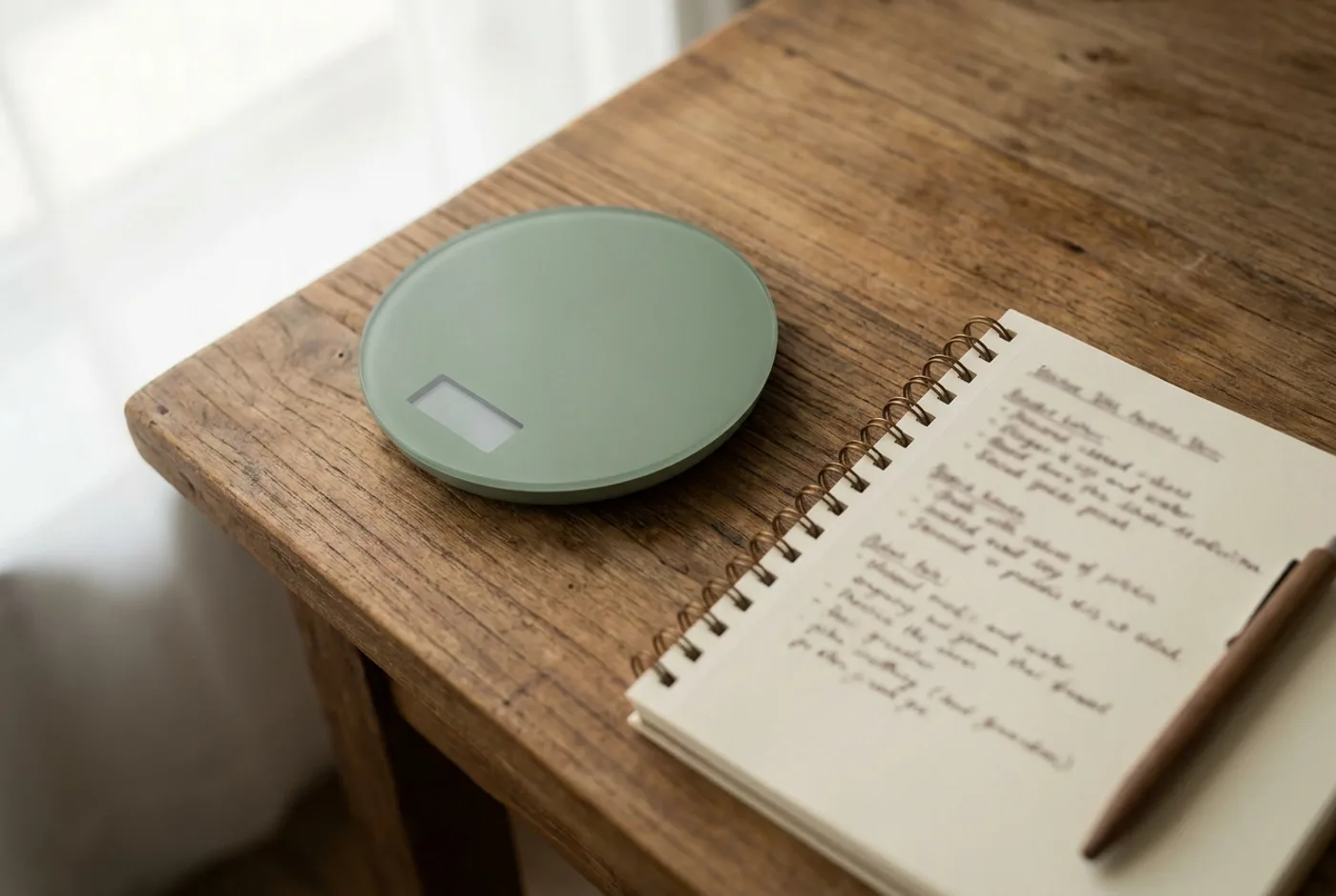
Weight, and why it beats everything else
If you only do one thing on this page, do this one.
Weight is objective, it's cheap, it changes before you notice anything else, and it's the number I'd rather have at a recheck than almost any other. It's also the thing almost nobody does, which means most owners arrive with an impression and I have to work from an impression.
Has she lost weight that matters?
Two weighings and the dates between them. Everything stays on your phone.
Put two weights in
Weigh her on the same day each week, ideally before a meal, on a kitchen scale with the carrier tared out.
The log, if you would rather use paper
Print this page and you get the table below with the rest of the page stripped out. It goes on the fridge, and six months from now it answers questions nobody can answer from memory.
| Date | Weight | Ate normally | Vomited | Litter box |
|---|---|---|---|---|
If you would rather keep the log on this phone than on the fridge, her notebook is the same four things, with a line you can see. Nothing is sent anywhere.
How, specifically: buy a digital kitchen scale, eight or ten dollars. Weigh the empty box or carrier, write that down once. Then put her in, weigh, subtract. Same day each week, before a meal if you can manage it, and record it with the date.
Bathroom scales won't do. They're built for a person and they round in units that hide exactly the change you're looking for. A quarter of a pound on a ten-pound cat is a meaningful signal, and a bathroom scale can't see it.
The threshold worth knowing: more than about five percent lost in a month is a phone call. That's roughly half a pound on a ten-pound cat. It usually means she's eating less than you believe, or she's nauseated, or something new has joined the picture. All three reward finding early.
Appetite, and what "eating" actually means
Yes or no, daily, is enough detail. What matters is catching a run of days.
Two things worth knowing about what you're watching for. A few licks of gravy is not eating. A cat who cleans the sauce off and leaves the rest has not had a meal, and that pattern usually means mild nausea rather than fussiness. And the pattern beats the day. One skipped meal is a cat. Three days of eating half of what she used to is information.
Beyond the bowl, the things that tell you she's nauseated rather than uninterested: licking her lips when there's no food about, swallowing repeatedly, drooling slightly, walking to the bowl and turning away, sitting hunched over the water dish without drinking. That's silent nausea and it's the usual picture, because most nauseated kidney cats never vomit. It's treatable, and it's the nausea page.
Water, without measuring cylinders
Nobody needs precise intake, and the cats who go outside or drink from taps make it impossible anyway.
Fill the bowl to the same line at the same time each day and notice whether it's emptier or fuller than usual. That's enough resolution to catch what matters.
For a rough anchor: a healthy cat drinks somewhere around 50ml per kilogram per day including the water in her food, so around a cup a day for an average cat. A kidney cat drinks more, and that's normal and expected rather than a problem. What matters is change in her own baseline.
Both directions are worth a call. A sharp increase can mean things have moved. A sudden decrease is often more urgent, because a cat who has stopped drinking dehydrates quickly, and dehydration is what makes a kidney cat crash.
The litter box, which tells you more than you'd like
Scoop daily and look, and if you have several cats, this is the argument for knowing whose is whose.
Urine. You're watching for the wet clumps to still be there and roughly their usual size. Kidney cats produce a lot of urine, so big clumps are normal for her. The alarming version is no wet clumps at all in twelve hours, which is an emergency, particularly in a male cat.
Straining with nothing produced is also an emergency, and in a male cat it's a drive-there-now, because a blockage is measured in hours. People reasonably assume straining means constipation, and in a male cat you cannot make that assumption from home.
Stool. Kidney cats get constipated because they're mildly dehydrated all the time and their stool dries out. Small hard pieces, or nothing for two days, is worth a call. Constipation is badly under-recognized and it makes a cat nauseated and off her food, so it's often the answer to a bad week. Black tarry stool is a different problem and needs a call the same day, because it means bleeding higher up.
The thresholds, in one place
Put this on the fridge next to the medication chart.
What not to bother with
A short list, because doing less of the wrong thing leaves room for the right thing.
Home urine dipsticks. They produce a number you can't interpret without context and mostly generate 11pm anxiety. If your vet asks you to collect a sample before a visit, do that. Otherwise leave the testing to the clinic.
Blood pressure cuffs, glucose meters, and anything else bought online to reassure yourself. A single reading from a stressed cat in a kitchen isn't information, and the equipment isn't validated for her.
Counting grams of food. It's a lot of effort for a signal that "she ate less again today" already gives you.
The things worth noticing that aren't measurable
Numbers aren't the whole picture, and you know this cat better than any panel does.
Is she still doing her three things, the ones that make her herself? Is she grooming? Is she choosing somewhere soft to sleep, or has she started lying somewhere cold and hard, which is what a cat who feels awful does? Is she restless at night?
That last one deserves weight. Cats tolerate pain better than they tolerate anxiety, and the not-being-able-to-settle, the 2am wandering, is often the real suffering. It's worth a phone call in its own right, and it's the heart of the quality of life page.
What to do with all of it
Take the notebook to every recheck. That's the whole point of collecting it.
Four weeks of weights and a note that she's eaten less since a week ago Thursday will change what your vet does, in a way that "she's been a bit quiet, I think" cannot. What a full recheck should include, and how often, is on the recheck page.
Questions people ask me about this
- What should I monitor in my cat with kidney disease?
- Four things: her weight once a week on the same day, whether she ate normally, roughly how much she drank, and whether the litter box looks right. Written down, with the date. Anything more elaborate is a chart you'll abandon by week six, and an abandoned chart tells your vet nothing.
- How do I weigh my cat at home?
- A cheap digital kitchen scale and a box or carrier. Weigh the empty box, put her in, subtract. Same day each week, ideally before a meal, written down. Bathroom scales can't resolve a ten-pound animal, and a quarter of a pound is a real signal here.
- How much water should a cat with kidney disease drink?
- More than a healthy cat, and the direction matters more than the figure. The 50ml per kilogram a day you'll see quoted, roughly a cup for an average cat counting what's in her food, is the healthy baseline; a kidney cat commonly runs well above it. What earns a call is change against her own normal, either noticeably more or a sudden drop.
- When should I call the vet about my CKD cat?
- Nothing eaten for twenty-four hours, repeated vomiting, cold ears and paws, pale or yellow gums, weakness or collapse, laboured breathing, straining in the litter box with nothing produced, or restlessness that's worse at night. Also any weight loss of more than about five percent in a month, and no wet clumps in the box in twelve hours.
- How much weight loss is a problem?
- More than about five percent in a month, so roughly half a pound off a ten-pound cat, earns a phone call rather than a wait. It usually means she's eating less than you think, or she's nauseated, or something new has joined the picture. All three are better found early.
- Do I need to test her urine or blood at home?
- No. Home dipsticks and pet glucose meters mostly manufacture anxiety, because one value with no context can't be read. The exception is urine your vet has asked you to collect ahead of a visit. Your job at home is the four simple things, done every week.
Medically reviewed by Dr. Steve Pelton, last updated . First published . Reviewed quarterly.