 KidneyCats
 Every medication your vet prescribed, explained
The short answer
Most kidney cats end up on some combination of a phosphorus binder, an antiemetic, an acid reducer, a blood pressure tablet, an appetite stimulant, and sometimes potassium. Each treats a different consequence of the disease. None of them treat the kidneys themselves, and three of them still slow it down.
What does each of my cat's kidney medications do?
You came home with a bag and a stapled sheet, and possibly six things to give at four different times. Here's what each one is for, in plain language, and where the detail lives if you want it.
One thing to say first, because it comes as a surprise: none of these treat the kidneys. Every drug on the list treats a consequence of the disease. That sounds like bad news and mostly isn't, because the consequences are what make her feel ill, and three of them also drive how fast she declines.
The ones that slow the disease, and the ones that make her comfortable
Worth knowing which is which, because it changes how you'd feel about missing a dose.
These slow it down: the phosphorus binder, the protein-loss drug, and the blood pressure tablet. They're doing structural work, quietly, and you won't see the benefit day to day. Give them faithfully anyway. Their whole value is in the long run.
These make her feel better: the antiemetic, the acid reducer, the appetite stimulant, potassium, and fluids. You'll see these working within days, sometimes within hours.
Comfort loops back into survival, though, which is why I don't rank them. A cat who feels well eats, and a cat who eats holds her weight, and weight is one of the strongest predictors of how she does.
The one distinction people get wrong
An antiemetic stops nausea. An appetite stimulant makes her hungry. They're different shelves and they get confused constantly.
Mirtazapine is an appetite stimulant. It has a mild anti-nausea effect at best. Giving it to a genuinely nauseated cat mostly makes her hungry and sick at the same time, which is not a kindness. Nausea gets treated first, and often the appetite comes back without needing anything else.
That's the whole argument of the nausea page, and it's the most common fixable mistake I see in this disease.
Getting them into her without a war
The plan matters less than whether it survives contact with a real cat at 7am on a Tuesday.
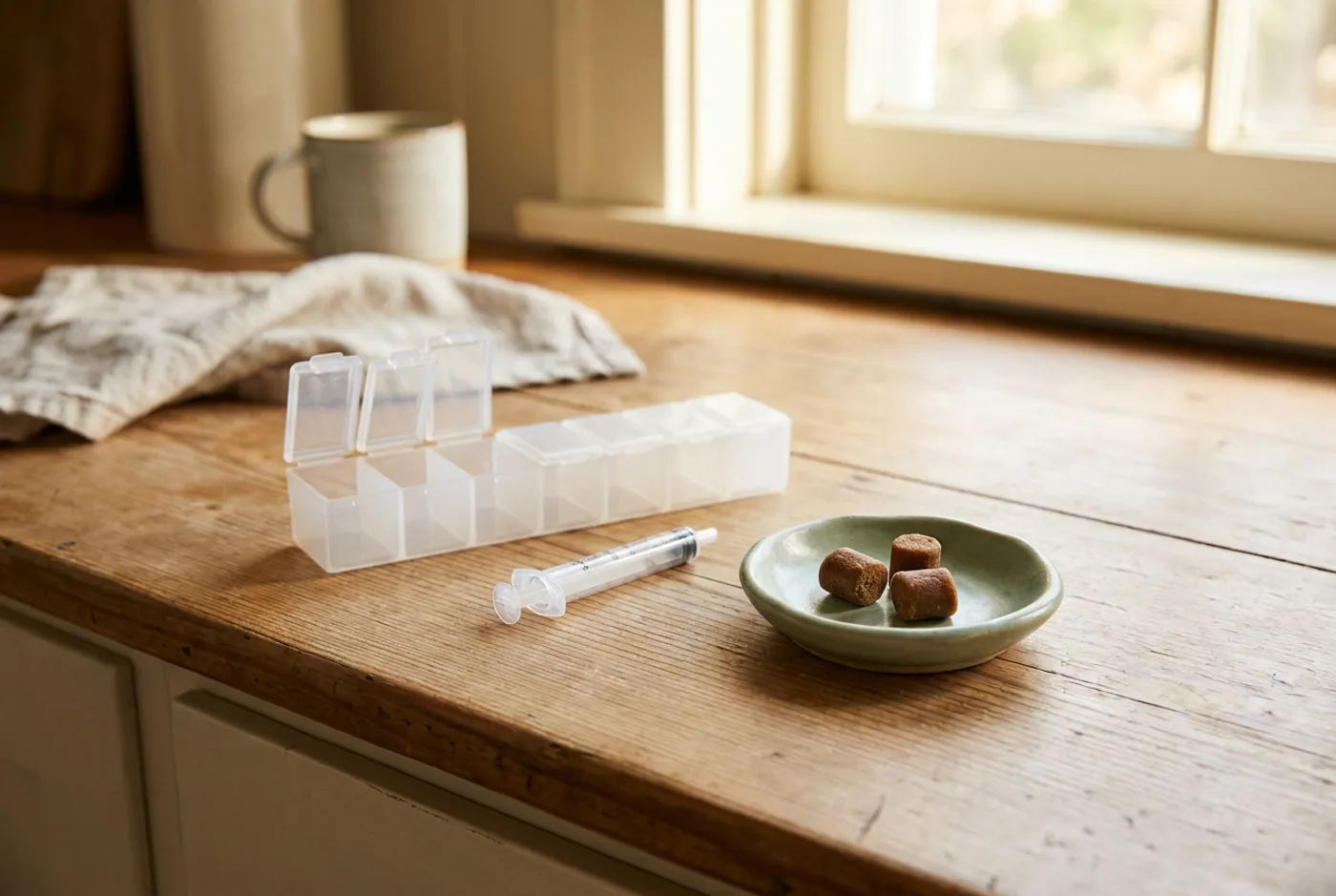
Test the vehicle empty first. Give her the pill pocket or the dab of treat paste with nothing in it, for two days. If she likes it, it's a treat and not a warning. If you introduce it already loaded, you've burned it.
Always follow a dry tablet with water or food. A few millilitres from a syringe, or a lick of something wet. A tablet that lodges in the oesophagus can cause real damage in a cat, and this is the single most skipped instruction in veterinary medicine.
Ask for a liquid or a transdermal if she fights. Plenty of these drugs can be compounded into a flavoured liquid, and some come as an ear ointment. If tablet time is becoming the worst part of both your days, that's a conversation, not something to endure. A medication you can actually give beats a better medication you can't.
Write out the real clock times and stick them on the fridge. Not the times you intend, the times you actually manage. Tick as you go. Two people in a house both giving the evening tablet is a real thing that happens.
Ask about spacing. Binders grab other drugs as well as phosphorus, so antibiotics and thyroid medication usually want a couple of hours' gap. Binders go in food. Some antibiotics prefer an empty stomach. Get your vet to write the sequence rather than working it out yourself.
Pilling, and the water afterwards
Video coming. I'm filming these myself.
What never goes in her, whatever the reason
Don't stop or change anything on your own
Two specific ones deserve naming.
Potassium. Low potassium is the common problem in the earlier and middle stages, and a supplement fixes it. But in late-stage disease, when she's producing little urine, potassium builds up instead, and high potassium affects the heart. A supplement that was exactly right in stage 2 can become actively harmful in late stage 4. It's decided on a rechecked blood value, never on symptoms or last year's prescription.
Blood pressure medication. Amlodipine is titrated against actual readings. Stopping it because she seems well removes the protection on her eyes and her kidneys, and doubling it because you're worried can drop her pressure too far.
If a drug seems to be causing a problem, that's a phone call rather than a decision. Most of the time there's an adjustment rather than a stop.
Where the detail lives
Each of these has its own page with the practical specifics, the doses to ask about, and the failure modes:
- Phosphorus binders, including why they only work mixed into food
- Nausea and vomiting, including the drugs to ask for by name
- Appetite, including the Mirataz over-dosing rules
- Blood pressure
- Potassium
- Anemia
And if the list has simply become too much to manage, that's a legitimate thing to raise at the next recheck rather than a personal failing.
Questions people ask me about this
- What does each of my cat's kidney medications do?
- Each one targets a consequence rather than the kidney itself. A binder lowers phosphorus, an antiemetic stops nausea, an acid reducer settles the stomach, amlodipine lowers pressure, telmisartan or benazepril cuts protein loss, mirtazapine or capromorelin drives appetite, potassium corrects weakness. None of them rebuild kidney tissue, because nothing does.
- Is there a medication that treats the kidney disease itself?
- No, and treat anything claiming otherwise as a sales pitch. The filters don't regenerate, so every drug on the list handles a consequence. That reads like a consolation prize and isn't: controlling phosphorus, proteinuria and blood pressure measurably slows the disease down.
- How do I give a cat a pill she won't take?
- Hide it in something strongly flavoured, and test the vehicle empty first so it isn't already under suspicion. Always chase a dry tablet with a little water or food, because a pill that lodges in the oesophagus does real damage. If it's a fight every single day, ask about a compounded liquid or a transdermal version rather than keeping the fight.
- Which human medications are dangerous for a cat with kidney disease?
- Any anti-inflammatory. Ibuprofen, naproxen and acetaminophen are all dangerous in cats and acetaminophen can be fatal, and a leftover meloxicam from another pet can take a kidney cat's function down fast. Aspirin isn't safe to dose at home either. Ask before anything from your own cabinet goes into her, and say so plainly if it already has.
- Can I stop a medication if she seems better?
- Not on your own. Blood pressure tablets and potassium are both dose-found against a blood value, and both can do harm if they're stopped or carried on at the wrong point. A potassium dose that was right at stage 2 can be dangerous at late stage 4. Raise it at the recheck and let the number decide.
- Do I have to give them all at the same time?
- Not necessarily, and a few need spacing. Binders grab other drugs as well as phosphorus, so antibiotics and thyroid medication usually want a couple of hours' clearance. Binders go in food, while some antibiotics prefer an empty stomach. Ask your vet to write out the actual clock times, then put that on the fridge.
Medically reviewed by Dr. Steve Pelton, last updated . First published . Reviewed quarterly.