 KidneyCats
 Anemia in later-stage kidney disease
The short answer
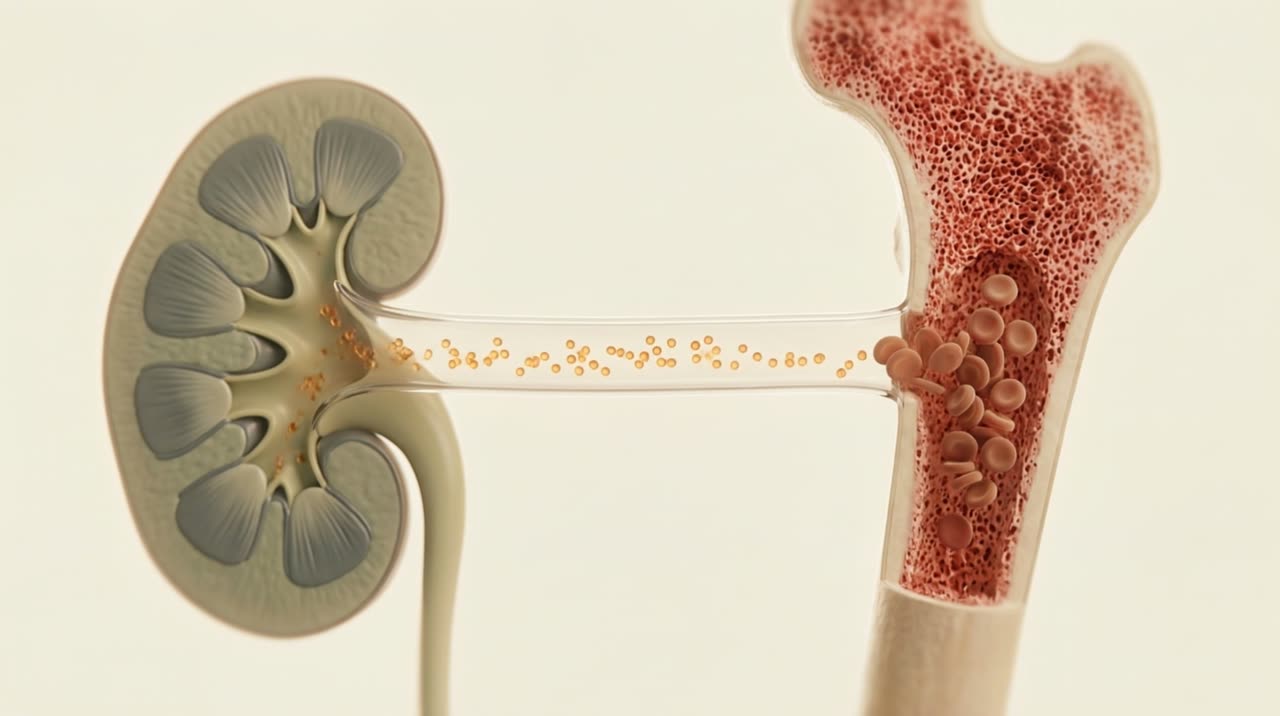
Healthy kidneys make a hormone that tells the bone marrow to produce red blood cells. As kidney tissue is lost that signal fades and she becomes anemic: tired, pale in the gums, breathless on small effort. It's a later-stage problem, it's treatable, and treating it can transform how an advanced cat feels.
Why is my CKD cat anemic?
Because the kidneys have a second job that nobody mentions until it stops working.
Alongside filtering, healthy kidneys produce a hormone called erythropoietin. Its whole function is to tell the bone marrow to make red blood cells. As kidney tissue is lost, that signal fades, the marrow makes fewer cells, and her red cell count drifts down.
Two more things pile on. Uremia shortens the lifespan of the cells she does make. And some kidney cats lose small amounts of blood into the stomach from uremic irritation, which quietly costs her more.
Red blood cells carry oxygen. Fewer cells means less oxygen reaching muscle and brain, and that's why an anemic cat is tired in a way that food and fluids don't fix.
What it looks like at home
Check her gums. This is a genuinely useful thing you can do yourself, and it takes five seconds. Lift her lip and look at the gum above a tooth. It should be bubblegum pink. Pale pink, white, or greyish is abnormal and worth a call.
Do it once now, while she's well, so you know her normal. Comparing against a memory is much harder than comparing against a fact you already have.
Alongside pale gums:
- Tired out of proportion to what she did, sleeping more, less interested in things she used to bother with
- Breathing fast, or breathing hard, after very small effort like walking up the stairs
- Weakness, wobbliness, reluctance to jump
- Poor appetite, which then makes everything else worse
- Occasionally something odd: eating litter, licking concrete or metal. That's called pica and in an anemic cat it's a real sign rather than a quirk
The trouble with all of these is that they're also what advancing kidney disease looks like generally, which is exactly why the red cell count belongs on her recheck panel rather than being inferred.
The number to ask for
Ask for her hematocrit or PCV, which are two names for the proportion of her blood made up of red cells, given as a percentage.
How it's treated
This is one of the more satisfying treatments in late-stage disease, so it's worth knowing it exists. Plenty of owners are never offered it.
Darbepoetin is an injection that replaces the missing hormone signal, telling the marrow to get back to work. It's typically given weekly at first, then stretched out as the count comes up. It isn't instant, because the marrow has to build the cells: expect a few weeks before you see a difference. Many cats are noticeably brighter once it works, and by brighter I mean eating, grooming, and getting back on the windowsill.
It needs monitoring. The count can overshoot, and a small number of cats develop antibodies against the drug, so bloodwork alongside it isn't optional.
Molidustat, sold as Varenzin-CA1, is the newer option: a liquid given by mouth rather than an injection, working on the same signal from a different angle. IRIS lists it alongside darbepoetin. It's conditionally approved rather than fully licensed, so not every practice stocks it, and it's worth asking about rather than assuming.
Iron usually goes with it, because the marrow can't build red cells without iron even when the signal is loud. Don't add iron on your own, though: too much iron is its own problem and it should be dosed against bloodwork.
A blood transfusion is a bridge, not a treatment. It works within hours, which is exactly what you want in a severely anemic cat who feels awful now, but it lasts days to weeks. It's used to buy time while darbepoetin starts working.
Treating what else is bleeding or blocking. If she's losing blood into her stomach, an acid reducer helps. If she's not eating, fixing that matters, because the marrow needs raw materials.
What it means for how long she has
Honest answer: anemia is a later-stage problem, and its arrival usually means the disease has advanced. That's real and I won't dress it up.
What it doesn't mean is that nothing can be done. A cat whose anemia is treated often has months of considerably better quality than she'd have had otherwise, and that's not a small thing to be offered.
Where it fits into the larger picture, including how to weigh treating versus not, is on the quality of life page. What a full recheck should include, so this gets caught rather than inferred, is on the recheck page.
Questions people ask me about this
- Why is my cat with kidney disease anemic?
- Healthy kidneys make erythropoietin, the hormone that tells the bone marrow to build red cells. As tissue is lost that signal fades and she builds fewer of them. Uremia shortens the life of the cells she does make, and some cats bleed slowly into the stomach as well. It's mostly a later-stage problem.
- What are the signs of anemia in a cat?
- Pale gums are the one you can check yourself: lift her lip, and bubblegum pink is what you want, rather than pale pink, white or grey. With it comes tiredness out of proportion to the effort, more sleeping, fast breathing after very little, weakness and a poor appetite. Some anemic cats start eating litter or licking concrete.
- Is anemia in kidney disease treatable?
- Yes, and it's one of the more rewarding things to treat this late on. Darbepoetin is an injection that replaces the missing signal, weekly at first and then less often, usually with iron alongside because the marrow can't act on the signal without it. Plenty of cats are visibly brighter inside a few weeks.
- How low is too low?
- Ask for the hematocrit or PCV as a number rather than a word. Normal for a cat runs roughly 30 to 45 percent. IRIS treats anemia caused by kidney disease at under 25 percent, and at 25 to 28 percent if it persists. A fast fall matters more than a settled low number, and in an early-stage cat it's worth ruling out another cause first.
- Does my cat need a blood transfusion?
- Sometimes, when she's severely anemic and needs to feel better today rather than in three weeks. It works within hours and lasts days to weeks, so it's a bridge while something longer-acting gets going. On its own it isn't an answer to a chronic problem.
- Will iron supplements alone fix it?
- Usually not, because the missing piece is the hormone signal rather than the iron. Iron still matters, since the marrow can't act on the signal without it, and cats on darbepoetin often need it alongside. Don't add it yourself: too much is a problem in its own right and it should be dosed on bloodwork.
Medically reviewed by Dr. Steve Pelton, last updated . First published . Reviewed quarterly.