 KidneyCats
 The first thirty days
The short answer
The first month is about building a routine you can actually keep, not doing everything at once. Week one is hydration and one medication at a time. Week two adds the food. Week three adds home monitoring. Week four is the recheck. If it's boring by day thirty, you've done this right.
What should I do in the first month after a CKD diagnosis?
You've come home with a diagnosis, a bag of things, and a strong urge to do all of it tonight. Please don't.
The single most common mistake in the first week isn't doing too little. It's doing everything at once, to a cat who feels unwell, until she hides from you and you're exhausted and neither of you knows which change caused what.
This is a month, not an evening. Here's the order I'd do it in.
The first thirty days, one week at a time
Every item here is from the four weeks written out below. Tick as you go. It stays on your own phone and nothing is sent anywhere.
-
Week one: water, one medication, and the appointment you are here
-
Week two: the food, slowly you are here
-
Week three: learn the home routine you are here
-
Week four: the recheck, and what to ask for you are here
Week one: water, one medication, and the appointment
Three jobs. That's the whole week.
Get more water into her. Wet food instead of dry wherever she'll accept it, more bowls in more rooms, wide shallow bowls rather than deep narrow ones, and a fountain if she's the sort of cat who likes moving water. This is the highest-value thing you'll do all month and it costs nothing.
Start one medication at a time. If she's been sent home with three things, ask which one matters most this week and start there, two or three days apart, unless your vet has said otherwise. Then when something upsets her you'll know what it was.
Book the recheck. Do it now, while you're thinking about it. Ask specifically when she should be back, because the interval genuinely differs. A stable early-stage cat might be three months out. A stage 4 cat, or a cat just started on fluids, a blood pressure drug or an ACE inhibitor, often needs to be seen inside a week or two.
What can wait: the food change, the supplements, the internet, and the survival statistics. All of it still works next week.
Do not do everything tonight
Video coming. I'm filming these myself.
Week two: the food, slowly
Now the diet, and slowly is the whole trick.
A kidney diet is lower in phosphorus, and lowering phosphorus is the intervention with the best evidence behind it in this disease. It buys time. Which is exactly why it's worth taking three weeks to introduce properly rather than three days and failing.
Mix a spoonful of the new food into her usual food. Sit at that ratio for a few days. Increase it a little. If she refuses, drop back to the last ratio she accepted and stay there longer. There's no prize for finishing early.
Two rules that save people weeks of trouble:
- Don't introduce the new food on a day she's feeling rough. Cats attach nausea to whatever they last ate, and you can burn the kidney diet permanently in one bad meal.
- Don't let her go hungry to force the change. A cat eating an ordinary food beats a cat refusing the correct one, every time.
If she simply won't have it, say so at the recheck rather than quietly giving up. A phosphorus binder mixed into food she does like recovers a good part of the same benefit. There's more on all of this on the kidney diets page.
Week three: learn the home routine
By now the medications are in and she's eating something. This is the week to add the skills.
If fluids have been prescribed, this is the week to get properly comfortable with them. The first one takes twenty minutes and you'll shake. The fourth takes four minutes. If it's going badly, ask a technician to watch you do one in the clinic. It's usually one small mechanical thing making it hard, and they would much rather spend ten minutes on that than have you give up at home. The full walkthrough is on the subcutaneous fluids page.
Set the medications up so you can't get them wrong. A paper chart on the refrigerator with the times you actually give them, not the times you intended to. Tick it as you go. Two people in a house both dosing the same cat at teatime happens more often than you would think, and a chart is how it stops.
Start writing four things down. Weight weekly, ate normally yes or no, vomited yes or no, litter box normal yes or no. Nothing more elaborate. More detail than that and you'll stop doing it by week six.
Watch for the small signals rather than the dramatic ones: she's licking her lips a lot, she comes to the bowl and turns away, she's in and out of the litter box, she's picked a new place to sleep that's cold and hard. Those are worth a phone call, and they're the things owners talk themselves out of mentioning.
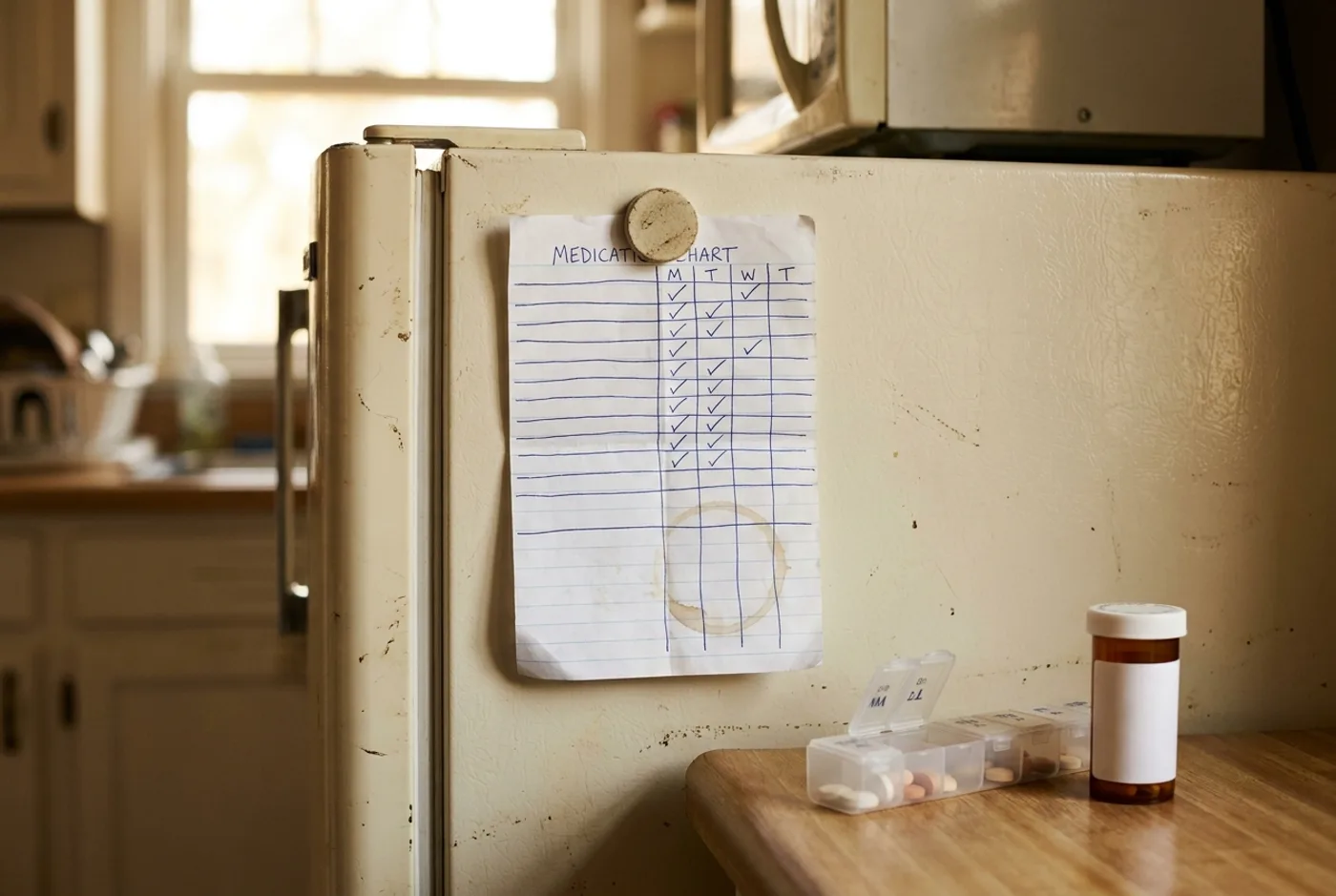
Ballpoint, some days missed, a coffee ring on it. That's what a real month looks like, and it works better than any app you'll stop opening by week three.
Week four: the recheck, and what to ask for
You'll be told what she needs. It's still worth knowing what a complete recheck looks like, because some of it gets skipped routinely.
- Weight, compared with the diagnosis weight. This is the scoreboard.
- Creatinine, phosphorus, potassium. Write the three numbers down with the date, every time.
- A UPC, urine protein to creatinine ratio, if she's never had one. Protein loss speeds the disease along and it's treatable with a specific drug your vet won't prescribe without the number.
- Blood pressure, if your vet has the equipment. Roughly one in five to one in three kidney cats is hypertensive, and it usually causes no symptom at all until it causes a permanent one, most often blindness. A lot of practices don't own a machine, and mine is one of them. That's workable. If yours doesn't, ask what they'd rather you watched for at home.
- A urine culture collected by cystocentesis, if her numbers have moved in the wrong direction without an explanation. A silent kidney infection is one of the more common reasons a cat suddenly gets worse, and it's curable with antibiotics. It's worth asking about by name because it's easy to miss.
Take your notebook. Take your weights. Ask what her recheck interval is now, since it may have changed.
There's a fuller breakdown of the values themselves on the bloodwork page.
Day thirty
Here's what I'd like the end of the month to look like. The medications happen without you thinking about them. The notebook has four weeks of weights in it. You know what her normal is well enough to notice when it changes. And the whole thing has become fairly boring.
Boring is the goal. Boring is what a well-managed chronic illness looks like from the inside.
Somewhere around day eight or ten, most people hit a low patch, once the urgency of the diagnosis has worn off and the routine hasn't set in yet. If you're in that stretch right now, it isn't a sign this won't work. It's the normal shape of the first month, and it lifts.
Questions people ask me about this
- What should I do first after my cat is diagnosed with kidney disease?
- Three things, in order. Book the recheck before you leave the clinic, or on the phone that week. Get water into her, which mostly means wet food and more bowls in more rooms. Start one medication at a time. Everything else, the diet included, can wait two weeks without costing her a thing.
- How soon should my cat be rechecked?
- It depends on her stage and on what has just been started, and one number doesn't cover everybody. A stable early-stage cat may be fine at three months. A stage 4 cat, or one just started on fluids, a blood pressure drug or an ACE inhibitor, usually needs to be back inside a week or two. Ask for hers specifically.
- Should I change her food right away?
- No. One thing at a time, and food isn't first. Switching a queasy cat onto a kidney diet is the quickest way to teach her to refuse it for good. Get her comfortable and hydrated in week one, then take two to three weeks over the change, mixing a little of the new into the old.
- What should I write down at home?
- Weight once a week on the same day, whether she ate normally, whether she vomited, and whether the litter box looks right. Plus the medications you actually gave, not the ones you meant to give. Six months from now that notebook answers questions nobody can answer from memory.
- Is it normal to feel completely overwhelmed in the first week?
- Yes, and it's usually worst around day eight to ten, once the adrenaline has worn off and the routine hasn't arrived yet. Almost everybody hits that dip, and almost everybody comes out of it. By the end of the month most people are dosing with one hand and thinking about something else.
- What should I ask for at the first recheck?
- Weight, creatinine, phosphorus and potassium. A UPC if she has never had one. A blood pressure reading if your vet has the equipment, and plenty don't. And if the numbers jumped for no clear reason, a urine culture collected by cystocentesis, because a silent kidney infection is common, treatable, and easy to miss.
Medically reviewed by Dr. Steve Pelton, last updated . First published . Reviewed quarterly.