 KidneyCats
 Kidney disease in a multi-cat house
The short answer
Two real problems: getting the right food into the right cat, and knowing whose output is in the litter box. Both are solved by separating them at mealtimes, and a microchip feeder if that fails. CKD isn't contagious, so your other cats are at no risk from her, though the older ones are worth screening.
How do I feed a kidney diet with other cats in the house?
Two problems, and they're the same two in every multi-cat house I've dealt with.
The right food has to get into the right cat. And you need to know whose urine, and whose stool, is in the litter box. Everything else is comparatively easy.
Feeding, solved properly
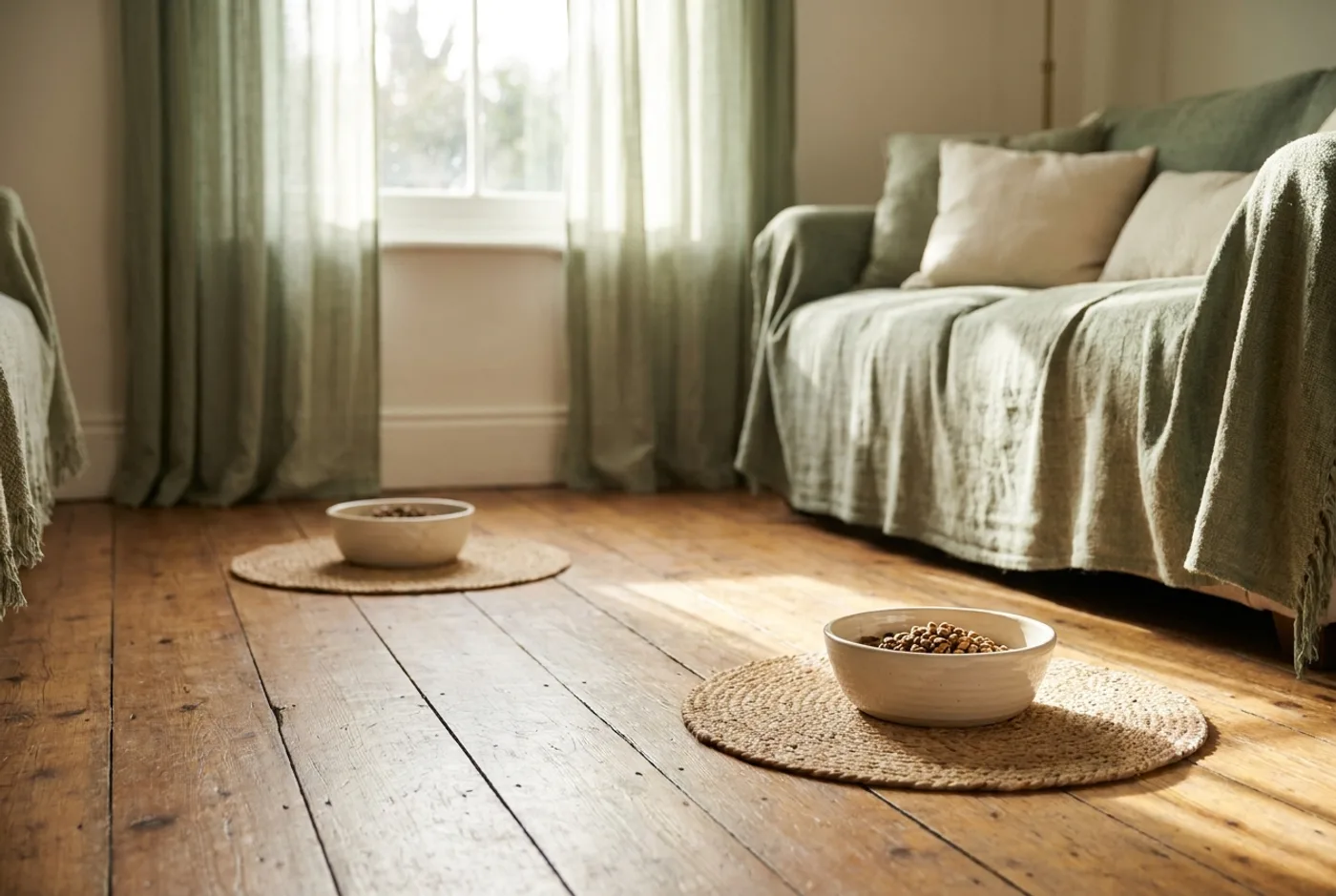
Stop free-feeding. This is the change that fixes most of it, and it's the one people resist because grazing is how the house has always worked. Set mealtimes, separate rooms, bowls down for twenty minutes, then up. Cats adapt to this in about a week and complain for three days.
Separate rooms matters more than separate corners. A determined cat will simply wait you out and eat from the other bowl the moment you turn around.
If one of them is a professional thief, a microchip-operated feeder is the real answer. It reads her chip and only opens for her, so the food is protected without you standing guard. They cost real money, and they're cheaper than a case of wasted renal food and a lot cheaper than the stress.
Feed the kidney cat first, so she isn't eating in a hurry with somebody watching her from the doorway.
Does it matter if the others steal some? A few mouthfuls, no. A renal diet is restricted in protein and phosphorus in ways a healthy adult cat doesn't need, so it's a poor long-term maintenance food, and it's genuinely inappropriate for a kitten or a pregnant cat. Occasional theft is fine. The whole house living on renal food is not the plan.
Does it matter if she steals theirs? More, unfortunately. That's her undoing the phosphorus control you're paying for. It's the strongest argument for separate rooms and for bowls coming up.
Water, which is easier than it looks
More bowls, in more rooms, is the whole strategy, and it happens to be exactly what a multi-cat house needs anyway.
Cats guard water sources without it looking like guarding. A bowl in a corridor that one cat has claimed is a bowl the others use less. Wide, shallow bowls, several of them, in places she already spends time, and at least one somewhere the other cats don't loiter.
If she's on fluids as well, a fountain isn't necessary. Availability matters more than novelty.
The litter box question
You cannot manage a kidney cat you can't see the output of, and in a three-cat house with two boxes, you can't.
More boxes. The usual guidance is one per cat plus one, and in this specific situation it earns its keep, because it makes it likelier she uses one you can attribute.
To find out whose is whose, the reliable methods are confinement and colour. Shut her in a room with her own box for a few hours, or put a distinctively different non-absorbent litter in one box. Your clinic will give you the non-absorbent beads, which double as the way to collect a urine sample.
What you're watching for is on the monitoring page: wet clumps present and roughly usual size, and stool that isn't hard, small or absent. Constipation is common in kidney cats and easy to miss when three cats share a box.
Uncovered boxes are better here. A hood hides exactly the information you're trying to collect.
Medicating her without an audience
Take her somewhere else, shut the door, and have everything ready before she arrives.
That applies to tablets and it applies double to fluids. Another cat wandering into the middle of a fluids session is how needles get pulled out and how a session she was tolerating becomes a session she remembers badly. Set up out of sight, door closed, and give her something excellent in there afterward so the room is associated with the good part rather than the procedure.
When she is being bullied
Sometimes separation is the answer, and the sign is that she's losing out on the things she needs.
Watch for: her leaving her food when another cat approaches, being blocked from the box or ambushed on the way out of it, being displaced from the warm sleeping spot, or spending all day somewhere high and out of the way when she never used to.
An old, thin, unwell cat is easy to push around, and a cat who's dropped down the pecking order because she's ill will quietly go without. Fix that with more resources in more places first: another box, another bowl, another bed somewhere warm and defensible, ideally not requiring a big jump. Then, if it's still happening, feed and rest her separately.
Your other cats
They can't catch it. CKD isn't contagious, so shared bowls, boxes and beds are not a risk.
But screen the older ones. The main risk factor for this disease is age, and your cats mostly share their age bracket. If you have another cat over about ten, ask for blood and urine at their next visit, including SDMA and urine concentration. That's how cats get caught in stage 1 or 2 rather than stage 3, and it's the single most useful thing this page can tell you.
Expect the others to notice her. Cats do register when a housemate is unwell, and the responses range from ignoring her to grooming her to becoming oddly pushy. None of that needs managing unless it's costing her food or rest.
A short setup that works
If you want the whole thing as a plan:
- Fixed mealtimes, separate rooms, twenty minutes, bowls up
- Kidney cat fed first, and fed somewhere she isn't watched
- One more litter box than you currently have, uncovered
- Extra water bowls, wide and shallow, in rooms she already uses
- Medications and fluids in a closed room, with something good afterward
- A warm bed at floor level she doesn't have to compete for
- The older housemates screened at their next visit
Food itself, including how to transition her without triggering a refusal, is on the kidney diets page. If you're going away and somebody else has to run all this, that's leaving a CKD cat with a sitter.
Questions people ask me about this
- How do I feed a kidney diet with other cats in the house?
- Separate rooms at set mealtimes, rather than food left down. Twenty minutes, then the bowls come up. For a determined thief, a microchip feeder that opens only to her chip settles it properly. Don't let the whole house live on renal food; it's a therapeutic diet, not a maintenance one.
- Is it bad if my other cats eat the kidney diet?
- It isn't poisonous, and a few stolen mouthfuls are nothing. It is restricted in protein and phosphorus in ways a healthy adult doesn't need, though, and it's a poor diet for a kitten or a pregnant cat. Occasional theft, fine. The whole house on renal food, no.
- Can my other cats catch kidney disease from her?
- No. This is an organ wearing out, not an infection, so shared bowls, boxes and beds carry no risk at all. If your others are past about ten, screen them at their next visit anyway, since age is the main risk factor and they have it too.
- How do I know which cat is drinking or urinating more?
- Separate them and watch, which is the only reliable method. Shut her in one room with her own bowl and box for a few hours. For the litter box specifically, a temporary switch to a distinctively coloured non-absorbent litter in one box tells you whose clumps are whose.
- How do I give fluids in a house full of cats?
- In a separate room, door shut, with everything set up before she comes in. An audience makes it worse, and another cat wandering into the middle of a session is how needles get pulled out. Give her something excellent in that same room afterwards.
- Should I keep her separated from the others permanently?
- No, unless she's being pushed off her food or bothered while she rests. Kidney cats hold up better inside their normal social world. What she needs is uninterrupted access to food, water and a box, plus somewhere quiet to retreat to, and that's usually more resources rather than a closed door.
Medically reviewed by Dr. Steve Pelton, last updated . First published . Reviewed quarterly.